VEGETABLES FROM NAVARRA
Asparagus of Navarra



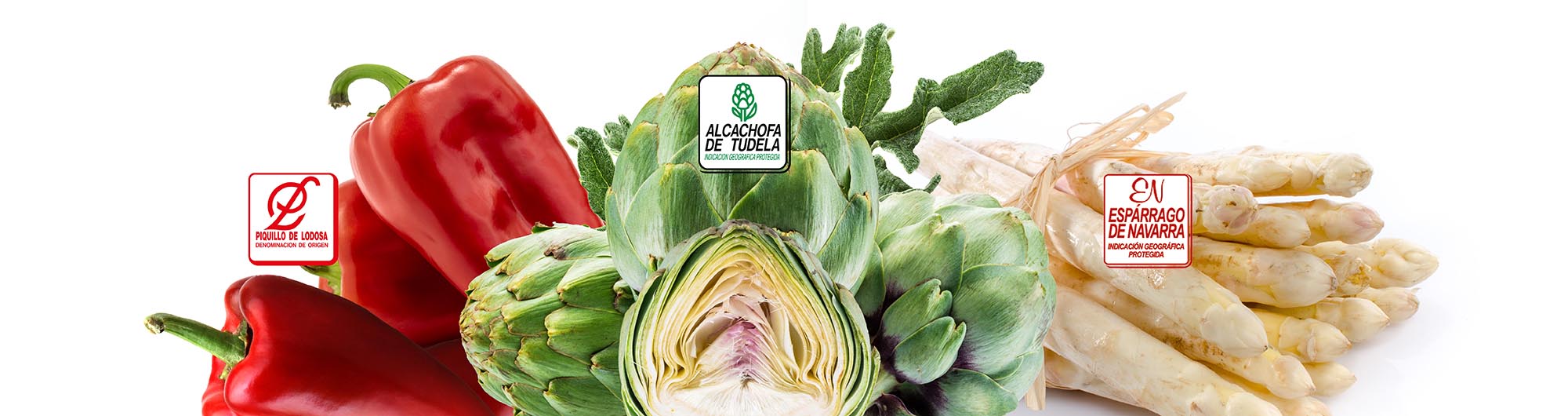
Asparagus from Navarra is a Protected Geographical Indication that began in 1986 with the aim of promoting and safeguarding the white asparagus produced in the protected area. The asparagus covered by the Protected Geographical Indication ‘Asparagus of Navarra’ is white in colour, smooth in texture, with little or no fibrousness. The perfect balance in the smoothness of its bitterness on the palate is due to the cold nights in the production area, the quality of the water and the cultivation systems used to obtain it.
Asparagus of Navarra protected area
Asparagus is one of the emblematic products of La Ribera del Ebro, a fertile and incomparable natural larder. On its banks lie the Communities of Navarra, Aragon and La Rioja, which comprise the production area of the Asparagus of Navarra under the PGI and is noted for its mild Mediterranean climate and a landscape dotted with hills and small mountain ranges. The protected area currently comprises 43 municipalities in Aragon, 38 in La Rioja and 176 in Navarra.
Caracteristics
The Asparagus of Navarra is a perennial plant with a productive life of six or eight years. It has a very powerful root system formed by a group of main roots which grow horizontally and from which the secondary rootlets grow.
The set of roots and buds is called the “zarpa”, which is planted in February by placing it at the bottom of a furrow and then covering it with soil. In spring the stems sprout and during this period and the summer the plant accumulates reserves in the roots to sprout vigorously the following year. In winter the plants are cut back and the appropriate soil preparation work is carried out.

Elaboration

First year
The set of roots and buds is called the “zarpa”. The plant is planted in February, placed at the bottom of a furrow and then covered with soil. In spring the stems sprout and during this period and the summer the plant accumulates reserves in the roots to sprout vigorously the following year. In winter, the plants are cut back and the appropriate soil preparation work is carried out.

Second year
Before sprouting begins, in the month of March of the second year, the appropriate work is carried out, the remains of the asparagus, which are already dry, are cut away and the asparagus is harvested, which consists of piling up the soil on the planting line to form a mound that will prevent contact with the light, so that the asparagus can be harvested as they grow. The asparagus is harvested daily until the end of the season, in June, when the asparagus is allowed to sprout again so that it can develop and accumulate reserves for the next season.

Harvesting
The asparagus will be harvested daily until the end of the season, in June, when the asparagus will be allowed to sprout again so that it can develop and accumulate reserves for the next season.
Marketing
Asparagus from Navarra is marketed fresh and canned, a format that does not require any culinary treatment and allows us to enjoy this delicacy all year round.

Canned
- The canning process of the Asparagus of Navarra begins as soon as the asparagus arrives from the field to the cannery. There they are selected and classified according to their size and are washed to remove any possible traces of soil.
- They are then peeled and cut by the stalk in order to equalise their size.
- They are blanched by immersion in hot water or steam and, after rapid cooling, the asparagus of the same characteristics are sorted.
- They are placed in containers which are filled only with asparagus, water and salt. There is the option of adding a preservative.
- Finally, the asparagus goes into the autoclave to undergo a heat treatment that ensures that the product's characteristics are maintained throughout its commercial life.
In any case, you will recognise them because they always carry the numbered back label that assures us that it is asparagus from Navarra.

Fresh
- Enjoying it is a luxury that is possible from mid-April to June, when it can be bought fresh. Fresh asparagus from Navarra is sold packaged and peeled or in the traditional way, unpeeled.
- In the warehouses, once the asparagus has been harvested, it undergoes rapid cooling with water, is selected and calibrated so that the packaging is homogeneous. In the case of peeled asparagus, it is peeled and packaged in such a way that it maintains its humidity, so that it reaches consumers in perfect condition
In any case, you will recognise them because they always carry the numbered back label that assures us that it is asparagus from Navarra.

Consumer tips
How do you peel them?
Hold the asparagus by the part of the bud and peel from top to bottom with a potato peeler or a kitchen knife, taking care not to touch the bud and turning it so as to peel the whole perimeter evenly. Finally, cut off the final part of the stalk and wash them in cold water.
How do you cook them?
Put a large pot of water in a high pan and, when it starts to boil, add salt and introduce the asparagus little by little, taking care not to break the boil. Boil for about ten minutes until they are tender and for the optimum cooking point it is recommended to prick them. Once cooked and drained, it is recommended to eat them warm to appreciate their flavour better, and with a drizzle of Extra Virgin Olive Oil from Navarra.

Buying guide
Asparagus from Navarra
Only the product covered by the P.G.I. Asparagus of Navarra may be accompanied by the name ‘DE NAVARRA’. And only the protected product may bear the logo and the numbered back label provided by the Regulatory Council in a clearly visible place.
They also bear the European Denomination of Origin logo as they are included in the Community register and may be accompanied by the Reyno Gourmet seal, which may be used together or separately in different areas of the packaging.
In order to differentiate the canned Asparagus from Navarra we must look for the logo and the back label of the P.G.I. Asparagus from Navarra and the European seal, always placed in a clearly visible place.
In addition, and finally, the label will include whether it is grown in Aragon, Navarra or La Rioja; the list of ingredients: asparagus, water and salt; the net quantity and drained weight; the number of fruits; and the best-before date.
List of companies
Fresh
- EL GERRIKO
- ESPÁRRAGO DE NOVILLAS
- FRUTAS SOLANO
- GRUPO AN | SECCIÓN HORTOFRUTÍCOLA
- LA CATEDRAL DE NAVARRA
- VEGETALES ALTO EBRO
Canned
- ANKO
- CONSERVAS ARTESANAS CAPULLO
- CONSERVAS ARTESANAS ROSARA
- CONSERVAS ARTESANAS SERRANO
- CONSERVAS ASENSIO
- CONSERVAS DE PUENTE LA REINA LATASA
- CONSERVAS ITURRI
- CONSERVAS LARRINAGA
- CONSERVAS LODOSA
- CONSERVAS OSES
- CONSERVAS RÍA | SON-RÍA
- CONSERVAS VITORI
- DANTZA
- EL ENCIERRO
- EL ESCOLAR
- EL JUNCAL
- EL MENDAVIES
- EL NAVARRICO
- EMPERATRIZ
- El Chaval
- FERBA
- GILVER
- JUANCHU
- JUANFE
- LA CATEDRAL DE NAVARRA
- LA TUDELANA | Deliconservas Medrano
- LINO MORENO
- LORES
- LOS TESOROS DE BARTOLO
- PEDRO LUIS
- PERON
- Sabor de Rioja
- VIUDA DE CAYOVELA
PGI Asparagus of Navarra
Learn about the history and everything about Navarra Asparagus I.G.P.